# Why Ultimate Digits?
Ultimate Digits is a public good, a basic piece of the digital payments infrastructure that belongs to the community.
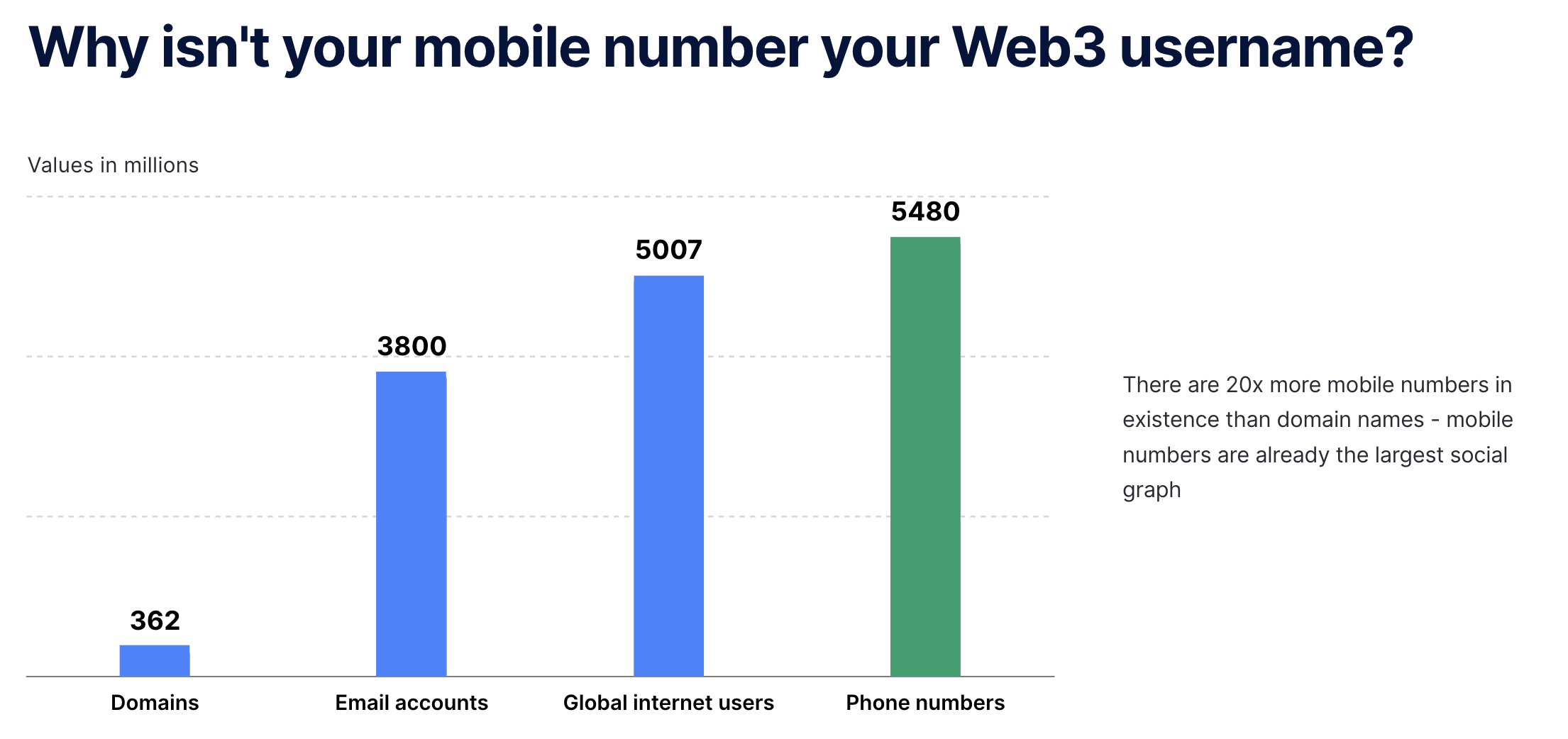
`Most of us have a mobile number but not a domain name`. Why should we be forced to learn a new behavior in Web3, and get a domain name as a wallet identifier? Since we already have mobile numbers, why don’t those become our wallet addresses?
This has been very successful in web2 fintech, where the Unified Payments Interface (UPI) enables users to abstract their bank account details to their mobile number. With UPI, users send bank transfers to their friends and merchants' mobile numbers. The transaction reaches the recipient bank account registered to that specific mobile number. This has made the sharing of complete bank details redundant. UPI is so successful that its usage has surpassed the other payment instruments by both transaction frequency and volume, in countries like India.
# About Ultimate Digits
Ultimate Digits is a public good, a basic piece of the digital payments infrastructure that belongs to the community.
Ultimate Digits makes users’ existing mobile numbers their existing crypto wallets’ addresses. For the privacy-conscious, we provide virtual Web3 mobile numbers as NFTs on Ethereum. These Web3 identifiers are ITU E164-compliant mobile numbers, starting with our unique +999 country code. Since most people are familiar with mobile numbers and use them in apps like WhatsApp, this system offers an intuitive Web2.5 bridge.
`Ultimate Digits is to ITU what ENS is to ICANN`. We start as a Web2.5 app, evolving into a super-app with decentralized VOIP, text alerts for wallet transactions, and hash key-based micro-transactions.
Our system securely links users' existing cryptocurrency wallets to their mobile numbers. This allows users to transfer cryptocurrencies and NFTs simply using the recipient's mobile number. Currently, users can send digital assets across different blockchain networks.
Our long-term goal is to integrate with UPI. This integration means that when you send cryptocurrency from your wallet, it can be converted into fiat currency and deposited into the recipient's bank account if they don't have a crypto wallet. If the recipient has a crypto wallet, they receive the assets there. If they have both, the sender can choose the destination account. This integration aims to make crypto transactions as convenient and frequent as fiat transactions.
# Why Now
Ultimate Digits is a public good, a basic piece of the digital payments infrastructure that belongs to the community.
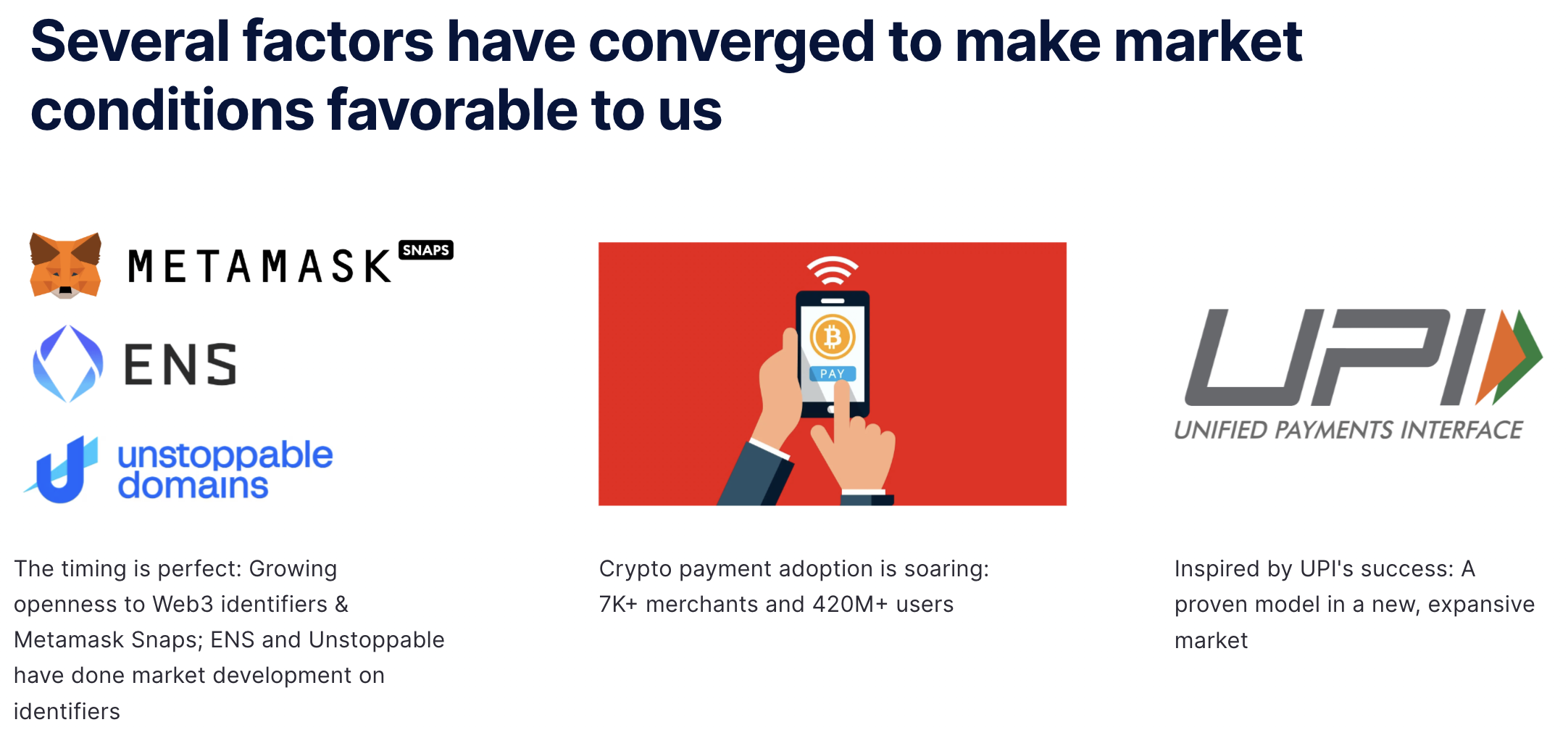
1. `Web3 domain services have already done the market education about the need for wallets and dApps to integrate alternative web3 identifiers into their products.` Now when we approach a wallet for integration, the cycle time has shortened significantly - they’re already open to integrating with products like ours that simplify user experience.
2. Consensys has released `Metamask Snaps` through which we can build micro-apps within Metamask in a permissionless manner. Given that Metamask is among the most popular crypto wallets currently, we can reach its user base via our Snap without needing to rely on a native integration that would be time-consuming and expensive.
3. Users in 12 countries (and counting) have already `experienced the convenience of UPI` and see merit in abstracting account details to mobile numbers. As of 2022, \~2600 merchants accepted payments in crypto in the US alone. This number is expected to multiply several-fold through 2030. Now is the time to build infrastructure to simplify payments and asset transfers.
# Our Vision
Ultimate Digits is a public good, a basic piece of the digital payments infrastructure that belongs to the community.
`Ultimate Digits is a protocol that simplifies crypto payments for retail users.` The long-term vision of our project is to become a Web3 super app that simplifies crypto asset transactions and establishes phone numbers as the primary identifier for Web3 utilities. We make crypto transactions more accessible by using phone numbers as crypto wallet addresses, similar to how UPI (Unified Payments Interface) simplified banking transactions in India.
**To achieve this vision, we have a strategic plan in place:**
1. Launch Web3 phone numbers as NFTs, initially targeting existing Web3 users who understand the concept.
2. Encourage existing Web3 users to invite their non-Web3 friends into the ecosystem through referral programs, leveraging network effects.
3. Onboard Web2 users by offering simplified peer-to-peer transfers, transaction notifications, self-custodial wallets linked to phone numbers, and multi-factor authentication.
4. Introduce decentralized VOIP as a feature that appeals to both Web3 and Web2 users and begin monetization, leveraging skeuomorphism design philosophy.
5. Continuously add new features such as decentralized P2P messaging.
6. Invite and empower other developers to build applications on our protocol, transitioning from a product to a platform, and ultimately becoming a super app (payments, decentralized VOIP, messaging, notifications, and more).
Through these steps, we expect to establish Ultimate Digits as the default Web2.5 standard for Web3 transactions and utilities, making crypto assets more accessible and simplifying life for existing Web3 users and newcomers.
**We’ll succeed by building a better user experience for existing and new retail Web3 users:**
1\. Simplification of p2p crypto asset transfers and payments
2\. Convenient Web3 transaction notifications
3\. Censorship-resistant, spam-free decentralized telephony. With this, we’ll do for telephony what ENS did for domains.
# Token ($ULT)
Ultimate Digits is a public good, a basic piece of the digital payments infrastructure that belongs to the community. $ULT is the native protocol token for Ultimate Digits.
**Immediate use cases for $ULT after launch:**
* VIP number auctions: Token staking unlocks the ability for people to purchase and bid on vanity, virtual NFT phone numbers. These vanity numbers are highly desirable based on our waitlist surveys.
* Tokens offset transaction fees on fungible tokens and NFTs (otherwise 0.1% for fungible).
* Voting on Tally DAO decisions. DAO design will consider Hick’s Law.
* Airdrop incentives and behavior nudging: To encourage community participation, referrals, and transaction frequency & volume.
**Future use cases:**
* Limitless wallet-to-wallet messaging for $ULT holders. Non-holders capped at 3 messages per day.
* Token-Based Authentication for ZKP Generation: Users must spend $ULT to generate the zk-SNARKs or zk-STARKs to facilitate changes of the wallets linked as payment addresses to Ethereum mobile numbers. This mechanism ensures that only legitimate users with a stake in the platform can initiate these sensitive operations, adding an extra layer of security against spam or malicious activities.
* Dynamic Time-Lock Fees: Users must spend $ULT to modify the default time-lock period for phone number changes or NFT transfers, while those willing to wait the standard duration would pay no fee. This creates a flexible system that can accommodate the urgency of different users' needs while also generating demand for $ULT.
* Current mobile number changes: All transactions related to changes of mobile (current numbers, not ETH numbers) numbers linked to wallets need users to pay a small fee in $ULT. This not only creates a consistent utility for the token but also helps to prevent spam and ensures that users are genuinely interested in making the transaction.
* User Verification: Leverage $ULT as a means to verify user identity during the phone number change process, where a certain amount of tokens could act as proof of identity or stake in the system, adding an extra layer of verification and trust.
* Salting & Hashing: This is the mechanism we use to protect the privacy of user data on chain. To avail of this utility, users need to spend a small amount of $ULT.
* High-quality decentralized VOIP services: available only to token holders, others get standard quality audio.
* eSIM: $ULT holders will be prioritized for eSIMs once they are available and we complete our MVNO setup.
* Secondary token: At some point in the future, when we transition to a DePIN model for connectivity to our eSIMs, we’ll launch an additional token to compensate node operators for providing coverage. Holders of $ULT will be airdropped allocation of this additional token too, based on snapshots of their holdings at various periods.
# Technical Overview
Ultimate Digits is a public good, a basic piece of the digital payments infrastructure that belongs to the community.
**Backend Infrastructure**
1. Blockchain Integration: Ultimate Digits uses a combination of Ethereum smart contracts to create and manage the link between mobile numbers and crypto wallet addresses. The use of Ethereum ensures decentralization and immutability.
2. Database: IPFS is used to store metadata about users. On BNB Chain, we’re using Greenfield.
3. API Server: A RESTful API server handles requests from the front end. Built using Node.js and Express.js, this server interacts with the Ethereum blockchain and IPFS.
**Smart Contracts**
4. Registration Contract: Users interact with this contract to link their mobile number to a crypto address. The actual mobile numbers aren’t stored on-chain, only a hashed version for privacy reasons. [Read our hashing mechanism.](https://docs.google.com/document/d/1L7yeGCIOwUUoxLRMBPLzjrGcHg7ETSoXb4hNtWriAQM/edit?usp=sharing)
5. NFT Contract: This contract handles the creation and management of virtual Web3 mobile numbers as NFTs. ERC-721 standard used adopted here. If a user links a real-world mobile number, an NFT is still created and deposited into their wallet.
6. Lookup Contract: This performs a lookup of the last owner of the above-mentioned NFT via {getOwnersForToken}. This NFT holder’s wallet address is retrieved for further use.
7. Ultimate Owners: We track NFT ownership changes via {NewOwner} and {Transfer} events. We use additional event logging, time-lock, and incentives to handle events like user’s mobile numbers being changed, or mobile number NFTs being transferred. [Read more here](https://docs.google.com/document/d/1HljYcR1Wk5Xjlr7lCBzEdF58HFF-ShwTRQOlwQbsdy4/edit?usp=sharing).
**Frontend**
8. Web App: React.js for frontend interface. It will integrate with Web3.js or ethers.js to communicate with the Ethereum blockchain. We’ll also develop Flutter-based mobile apps.
9. MetaMask Snaps Plugin: This will be developed using the Snaps beta SDK provided by MetaMask. It'll be a micro-app that can be plugged into MetaMask.
**Security**
10. Hash Functions
11. Smart Contract Audits
12. Oracles: For external data such as real-time token prices, decentralized oracles will be used to provide reliable data feeds.
13. Interoperability: Ultimate Digits is a fully open system where mobile numbers can be set to any kind of record, with blockchain addresses being the most common use case.
**DAO Governance:** Eventually, we’ll turn the protocol governance over to a DAO to ensure that it remains in the hands of its users.
# Salting & Hashing
This is the mechanism we use to protect the privacy of users' mobile numbers on-chain at Ultimate Digits.
**Ultimate Digits Hashing Rule**
*Preliminary Steps*
1. Normalize the data, remove any spaces, and strip any non-numeric characters from the mobile number.
2. Ensure the mobile number has a consistent format. Since we’re targeting international numbers, we always use the full international version. E.g., +1 123 456 7890 becomes 11234567890.
*Ultimate Digits Extraction*
Extract the last n digits from the mobile number where n is a predetermined value (for example, 4). This is referred to as the 'Ultimate Digits'.
*Salting*
Combine the 'Ultimate Digits' with a user-specific salt. The salt can be derived from the user's crypto address or another unique user-specific identifier (randomized salting pattern). The salt ensures even if two users have the same 'Ultimate Digits', their hashes will differ.
`SaltedValue = Ultimate Digits + Salt`
*Hashing*
We use a cryptographic hash function to hash the SaltedValue. We use the keccak256 hash function (standard for Ethereum).
`UltimateDigitsHash = keccak256(SaltedValue)`
*Storing on the Blockchain*
Store the UltimateDigitsHash on the blockchain. This value can be used for verification without revealing the actual mobile number.
**Verification**
1. When a user wants to verify or change their number, they'll undergo the same process to generate a new hash.
2. The newly generated hash is then compared with the one on-chain to confirm a match.
**Implementation Example**
1. Suppose a user has the mobile number "11234567890" and their Ethereum address (used as a salt) is "0xabc...123".
2. The last 4 digits (Ultimate Digits) are 7890.
3. Salted value becomes 7890abc...123.
4. Hash the salted value with keccak256 to get UltimateDigitsHash.
5. Store this hash on-chain.
# Zero Knowledge in Ultimate Digits
This describes the various methods we employ to secure handle users' mobile number changes in Ultimate Digits.
User's real-world mobile number, linked to their crypto wallet via Ultimate Digits, is changed.
*Zero-Knowledge Proofs (ZKPs) and Chain of Custody*
1. The user employs a zk-SNARK (Zero-Knowledge Succinct Non-Interactive Argument of Knowledge) protocol to produce a proof, which confirms knowledge of both old and new mobile numbers without revealing them.
2. This ZKP is then hashed using a cryptographic hash function (SHA-256) and stored in the Chain of Custody ledger.
*Time-Lock*
The change request initiates a smart contract, which puts the change request in a pending state for a predetermined time period (72 hours) using Ethereum's block.timestamp to track the start and end of the locking period.
*Notifications*
Utilizing Ethereum's event logging functionality, an event is emitted when the change is queued. Our internal service (using oracles listening to these events) then sends out the alerts to users’ Ultimate Digits apps.
*Decentralized Reporting*
Nodes running the Ultimate Digits protocol continually validate the Chain of Custody against consensus rules. Any discrepancies trigger alerts in the network, potentially leading to transaction rollbacks or other corrective actions.
The user sells the virtual number NFT to a different user.
*Zero-Knowledge Proofs (ZKPs) and Chain of Custody*
1. The transfer of an NFT involves a zk-STARK (Zero-Knowledge Scalable Transparent Argument of Knowledge) to prove ownership without disclosing the ownership details.
2. Post validation, this ZKP is hashed and recorded on the Chain of Custody blockchain.
*Time-Lock*
A smart contract manages the NFT transfer, enforcing a time-lock using Ethereum's block.timestamp to ensure a verification period.
*Notifications*
An Ethereum event is emitted upon a queued NFT transfer, prompting our internal service (using oracles listening to these events) to send out the alerts to users’ Ultimate Digits apps.
*Decentralized Reporting*
Any illicit attempt to double-spend the NFT or breach the protocol is flagged by consensus nodes, ensuring that NFTs remain unique and untampered.
# Protocol Roadmap
Ultimate Digits is a public good, a basic piece of the digital payments infrastructure that belongs to the community.
`Milestone 1 (Current)`
* Testnet v3 (React web app):
1. Purchasing virtual mobile numbers as NFTs
2. Linking mobile numbers to crypto wallet addresses
3. Using phone number identifiers in lieu of wallet addresses to send/receive crypto
* Phone number registry for virtual numbers
* Classification of phone numbers into categories for price determination and auction rules setup
* NFT contracts with virtual phone numbers
* Rule-based AI for recommendation algorithm to suggest people virtual phone numbers for purchase
* Magic Labs integration
* Coinbase embedded wallet integration
* Coinbase auth integration
* Coinbase Pay integration
* Airdrop farming page
* Telegram Bot
`Milestone 2 (June to September 2024)`
* Mainnet v1 (React web app)
* Fiat onramp integration
* Three token utilities go live (rewards utility i.e. Ultimate Rewards v1)
* NFT checkout integration
* Twilio integration (for onboarding)
* CMS v1 with Plerdy integration
* PayNow sandbox integration
* Metamask Snap
`Milestone 3 (October to December 2024)`
* DAO governance setup via Snapshot
* Flutter app testnet v1 (feedback via Canny)
* SendGrid or Brevo integration
* Fractal ID integration (for user KYC)
* Fractal ID integration (for Fractal logins)
* REST API for dAapp integration (wallet-focused)
`Milestone 4 (January to April 2025)`
* REST API for dAapp integration (wallet-focused)
* Flutter mainnet - release APK and TestFlight access
* Mainnet v2 (web app)
* V1 release of Web3 notifications service -> text/SMS messages (additional token utility)
* CMS v2
* Staking pool (additional token utility)
* Produktly or Appcues integration for higher user activation rates
* PayNow integration go-live
`Milestone 5 (May to July 2025)`
* V1 release of Web3 notifications service -> push notifications
* Web3 phone numbers <> RWA numbers relay
* Ultimate Rewards module v2
* Play Store and App Store release
* Multi-Factor Authentication v1 (additional token utility)
`Milestone 6 (August to October 2025)`
* Decentralized VOIP (dVOIP) testnet
* Integration exploration with BlockLess for node management for dVOIP
* Molly fork testnet
* MVNO integration commencement
`Milestone 7 (November to January 2026)`
* Decentralized VOIP v1 (additional token utility) \[feedback via Canny or ProductLift]
* Molly fork v1 (additional token utility) \[feedback via Canny]
* CMS v3
* Additional chain support